Moped vs scooter is one of those searches that returns the same three paragraphs everywhere: a moped is 50 cc, a scooter has a step-through frame, a motorcycle is bigger. Below them sits an insurance blog, a dealership in Jacksonville, a Reddit thread, and — on both of the searches I ran — a row of shops selling electric kick scooters, answering a question nobody asked.
None of those pages quote a definition. So I went and read the definitions instead: the European type-approval regulation, the European driving licence directive, the British statute and the Highway Code, the American federal safety standards, and the vehicle codes of two American states that treat the identical machine in opposite ways.
The first thing that falls out is not a detail. One of those three words does not exist in vehicle law. Not “rarely used” — absent. I counted.
The short version, before the documents
- In Regulation (EU) No 168/2013, the regulation that decides what every two-wheeler sold in Europe legally is, the word “scooter” appears zero times. In Directive 2006/126/EC, the one that decides what licence you need, it appears zero times. In 49 CFR 571.3, the American federal definitions section, it appears zero times — and so does “moped”.
- “Moped” is a legal category with three numbers attached: 50 cm³, 45 km/h, 4,000 watts. “Motorcycle” is a legal category too. “Scooter” is a shape of bodywork. That is the whole answer, and everything below is the consequence.
- European law defines a motorcycle by what it is not: a two-wheeler “that cannot be classified as category L1e”, the moped class. Fail the moped test on any single number and you are a motorcycle.
- A 49 cc petrol scooter with no pedals is a moped in Washington State and, read against the statute, a motor-driven cycle — a species of motorcycle — in California. Same machine, same engine, one state line.
- That is not a trivia point: in Washington any driver’s licence rides it with no extra exam, while in California a Class C car licence explicitly does not cover it.
- Mopeds are banned from motorways in Britain and from limited access highways in Washington, in almost the same words, and neither rulebook uses the word scooter to say it.
- The word “scooter” does appear in two American statutes I read. In both it means the stand-up kind with a floorboard, and Washington caps it at twenty miles per hour by design. Legally, “scooter” is the thing on the pavement, not the thing you are riding.
- Asking whether scooters are safer than motorcycles has no answer in the American crash data, because that data counts mopeds and motor scooters as motorcycles and its smallest engine bucket is “up to 500 cc”.
One of these three words is not a legal category
I ran the count myself on the consolidated texts, which is why I can put a number on it rather than an impression.
Regulation (EU) No 168/2013 is the type-approval regulation for L-category vehicles: it is the document that decides, for every powered two-wheeler sold in the European Union, which box it goes in. Across its whole consolidated text, “moped” appears 21 times. “Scooter” appears zero times.
Directive 2006/126/EC is the driving licence directive, the one behind the AM, A1, A2 and A categories printed on European licences. “Moped” appears there too. “Scooter” appears zero times.
And 49 CFR 571.3, the definitions section of the American Federal Motor Vehicle Safety Standards, contains neither. No “scooter”, no “moped”. It has exactly two relevant entries:
Motorcycle means a motor vehicle with motive power having a seat or saddle for the use of the rider and designed to travel on not more than three wheels in contact with the ground.
Motor-driven cycle means a motorcycle with a motor that produces 5-brake horsepower or less.
Three legal systems, three counts of zero. When a shop assistant, an insurer or an article tells you that “a scooter is X”, they are describing a body style: step-through frame, floorboard for the feet, engine under the seat, usually a twist-and-go transmission. That description is real and useful. It just has no legal effect anywhere I could check — with one exception I found later, and owe you here: the word is defined in FMVSS No. 123, the American federal standard on motorcycle controls, and it is defined there because of automatic transmissions, which is a story I told in automatic motorcycles. The category that has legal effect is moped, and it is defined by numbers.
What a moped is, in numbers
Annex I of Regulation 168/2013 sets out the common classification criteria. For category L1e, the light two-wheel powered vehicle, they are these:
engine capacity ≤ 50 cm 3 if a PI internal combustion engine forms part of the vehicle’s propulsion configuration
maximum design vehicle speed ≤ 45 km/h
maximum continuous rated or net power ( 1 ) ≤ 4 000 W
The odd spacing is how the regulation prints it. Three ceilings, and the vehicle has to be under all three at once. Fifty cubic centimetres if it burns petrol, forty-five kilometres per hour of design speed, four kilowatts of continuous power.
Inside L1e there are two sub-categories, and the way the second one is written is worth reading twice:
L1e-B Two-wheel moped (9) any other vehicle of the L1e category that cannot be classified according to the criteria (9) to (12) of a L1e-A vehicle.
L1e-A is the powered cycle: pedals, assistance that cuts out at 25 km/h, one kilowatt. A moped, in European law, is defined as the L1e that is not a powered cycle. The same regulation also decides how heavy any of these machines officially is, and that turns out to be a question with seven legal answers and none of them called dry weight. Which is to say, the whole class is drawn by subtraction, and that habit continues one rung up.
And a motorcycle is defined as “not a moped”
Here is the criterion for category L3e, the two-wheel motorcycle, in Annex I of the same regulation:
two-wheel vehicle that cannot be classified as category L1e
That is it. There is no minimum displacement for a motorcycle in European law, no minimum power, no minimum weight. A motorcycle is a two-wheeler that failed the moped test. Exceed 50 cm³, or exceed 45 km/h of design speed, or exceed 4,000 watts — any single one of the three — and the machine changes category, changes licence, changes the roads it may use.
The sub-categories then split motorcycles by performance rather than by looks:
L3e-A1 Low-performance motorcycle (7) engine capacity ≤ 125 cm 3 and (8) maximum continuous rated or net power ( 1 ) ≤ 11 kW and (9) power ( 1 )/weight ratio ≤ 0,1 kW/kg.
Which is why a 125 cc twist-and-go scooter and a 125 cc naked bike sit in exactly the same legal box, need exactly the same licence, and are separated by nothing except the shape of the plastic. If you are choosing between the two, the decision is ergonomic and financial, not legal — and it belongs in the same conversation as choosing a first motorcycle, not in a separate one.
Britain draws the same line, then adds a date
The Road Traffic Act 1988 defines the upper side of the line directly. Section 108 says:
“motor bicycle” means a motor vehicle which— (a) has two wheels, and (b) has a maximum design speed exceeding 45 kilometres per hour or, if powered by an internal combustion engine, has a cylinder capacity exceeding 50 cubic centimetres, and includes a combination of such a motor vehicle and a side-car
Note the “or”. Faster than 45 km/h by design, or bigger than 50 cc: either alone makes it a motor bicycle. And for the lower side, the same section simply points at Europe:
“moped” does not include light quadricycles, but otherwise has the same meaning as in Directive 2006/126/EC
So the British line and the European line are the same line. What Britain adds is a set of gates on top of it. The government’s own category table reads:
Mopeds with speed range of 25 km/h to 45 km/h — AM — Compulsory basic training ( CBT ), theory test, practical test on all powered 2-wheeled moped — 16
Light motorcycle up to 11 kW (and a power-to-weight ratio not more than 0.1 kW per kg) and 125 cc — A1 — CBT, theory test, practical test — 17
Standard motorcycle up to 35 kW — A2
That lower bound of 25 km/h is not decoration. Directive 2006/126/EC defines category AM as two- and three-wheelers with a maximum design speed of not more than 45 km/h, “excluding those with a maximum design speed under or equal to 25 km/h”. Below 25 km/h you fall out of the moped category downwards, into the world of pedal assistance.
And then there is the date, which catches people out every year:
You do not need to take compulsory basic training ( CBT ) to ride a moped if you passed your car driving test before 1 February 2001. You’ll still need to complete CBT to ride a motorbike, however.
You need to take CBT to ride a moped if you passed your car driving test on or after 1 February 2001.
Two people of the same age, same car licence, same 50 cc machine. One passed a car test in January 2001 and may ride it with no training at all; the other passed in March 2001 and must do a day’s CBT first. Nothing about the vehicle decides that. A date on a licence does.
America never drew the line at all
Go looking for the federal American definition of a moped and there is nothing to find. As quoted above, 49 CFR 571.3 gives you “motorcycle” and “motor-driven cycle” and stops. The threshold in the federal definition is not displacement or speed but brake horsepower: five or less and it is a motor-driven cycle, which is still a motorcycle.
Everything else — whether the machine is called a moped, what licence it needs, whether it gets a plate, which roads it may use — is left to the states. Which means the answer to “moped vs scooter” in America is not one answer. It is fifty. I read two of them properly, chosen because they land on opposite sides.
The same 49 cc machine: a moped in Washington, a motorcycle in California
Washington first. The definition is in RCW 46.04.304:
“Moped” means a motorized device designed to travel with not more than three wheels in contact with the ground and having an electric or a liquid fuel motor with a cylinder displacement not exceeding fifty cubic centimeters which produces no more than two gross brake horsepower
with the ceiling stated a few words later:
capable of propelling the device at not more than thirty miles per hour on level ground
Fifty cubic centimetres, two brake horsepower, thirty miles per hour. A typical 49 cc twist-and-go scooter meets all three. In Washington it is a moped, and the motorcycle definition says so explicitly, by exclusion:
“Motorcycle” excludes a farm tractor, a power wheelchair, an electric personal assistive mobility device, a motorized foot scooter, an electric-assisted bicycle, and a moped.
Now California. The definition is in Vehicle Code section 406:
A “motorized bicycle” or “moped” is a two-wheeled or three-wheeled device having fully operative pedals for propulsion by human power, or having no pedals if powered solely by electrical energy, and an automatic transmission and a motor that produces less than 4 gross brake horsepower and is capable of propelling the device at a maximum speed of not more than 30 miles per hour on level ground.
Read the first clause slowly, because everything turns on it. To be a moped in California the device must have fully operative pedals — or no pedals only if it is powered solely by electrical energy. A 49 cc petrol scooter has no pedals and is not electric. It fails the definition at the first hurdle.
So what is it instead? Section 400 defines a motorcycle as a motor vehicle with a seat or saddle designed to travel on not more than three wheels in contact with the ground, which the scooter plainly is. And section 405 narrows that:
A “motor-driven cycle” is any motorcycle with a motor that displaces less than 150 cubic centimeters. A motor-driven cycle does not include a motorized bicycle, as defined in Section 406.
Follow the three sections in order — 406 excludes it, 400 catches it, 405 sub-classifies it — and the same 49 cc machine that is a moped in Washington is a motor-driven cycle, a species of motorcycle, in California. That chain of reasoning is mine; the three definitions are the state’s, quoted above in full.
I want to be careful about the reach of this. Two states are two states, not fifty. What the pair demonstrates is not a rule about America but the absence of one: with no federal definition to anchor it, the word moped means whatever each legislature decided it meant, and at least two of them decided differently about the most common small machine on the road.
So do you need a licence for a moped?
This is where the two states stop being a curiosity and start costing money.
Washington, RCW 46.20.500:
a person sixteen years of age or older, holding a valid driver’s license of any class issued by the state of the person’s residence, may operate a moped without taking any special examination for the operation of a moped
Any licence, no extra exam, from sixteen. California takes the opposite view of the same machine. Its licence classes are set out in Vehicle Code section 12804.9, and the car class is defined partly by what it excludes:
Class C does not include a two-wheel motorcycle or a two-wheel motor-driven cycle.
Class M1. A two-wheel motorcycle or a motor-driven cycle.
Class M2 includes a motorized bicycle or moped, or a bicycle with an attached motor
A pedal-less petrol scooter, having been pushed out of the moped definition and into motor-driven cycle, lands in M1 territory — the full motorcycle class — while the pedalled or electric machine that does qualify as a moped needs only M2. In Washington, the same machine needs nothing beyond the licence already in the rider’s wallet.
Britain, meanwhile, gates it by training rather than by class: CBT plus theory and practical for category AM at sixteen, unless the pre-2001 car test exempts you, as quoted earlier. And the European minimum is written into the directive itself:
the minimum age for category AM is fixed at 16 years
Four jurisdictions, four different answers, and not one of them asks what the machine looks like.
Plates and registration
The pattern repeats in the paperwork. California, Vehicle Code section 5030, in a single sentence:
A motorized bicycle, as defined in Section 406, is required to display a special license plate issued by the department.
Washington, RCW 46.61.710:
No person shall operate a moped upon the highways of this state unless the moped has been assigned a moped registration number and displays a moped permit
Both states register mopeds and both make them carry identification, but they do it through separate regimes with separate documents rather than folding them into ordinary motorcycle registration. If you buy a used one privately, that is the paperwork to ask for by name, and it is worth checking before money changes hands for the same reason it is worth checking a used motorcycle properly before buying it.
The motorway question, and the two rulebooks that agree
Can a moped or a 50 cc scooter go on the motorway? Both rulebooks I read say no, and both say it without ever using the word scooter.
The Highway Code, rule 253:
Motorways MUST NOT be used by pedestrians, holders of provisional motorcycle licences, riders of motorcycles under 50 cc (4 kW), cyclists, horse riders, certain slow-moving vehicles and those carrying oversized loads (except by special permission), agricultural vehicles, and powered wheelchairs/powered mobility scooters
The capitals are the Highway Code’s own convention for a legal requirement rather than advice. Notice also that the rule does not say “mopeds”: it says motorcycles under 50 cc, with the power ceiling in brackets. The category the rule bites on is the size of the engine, not the name of the vehicle.
Washington, RCW 46.61.710, subsection 3:
Operation of a moped, electric personal assistive mobility device, or motorized foot scooter on a fully controlled limited access highway is unlawful.
Same prohibition, different vocabulary, both aimed at the same physical problem: a vehicle whose design speed is 30 mph or 45 km/h has no business on a road where the traffic is doing double that. Which is the practical point buried under all the terminology, and the one that should shape the decision if the machine is meant to get you to work — a question I went into properly in what commuting by motorcycle actually involves.
How fast a moped goes is a ceiling, not a specification
How fast a moped goes is the question everybody asks, and the honest answer is that it is asking about a legal ceiling rather than a performance figure.
In Europe and Britain the number is 45 km/h of maximum design speed, from Regulation 168/2013 and reproduced in the Road Traffic Act’s mirror-image definition of a motor bicycle. In Washington and California the number is 30 miles per hour on level ground, which is 48 km/h, so the two systems land within a whisker of each other by different routes.
Two things follow, and they are more useful than the number itself.
The first is that these are design ceilings, so downhill, with a tailwind, or with a rider who weighs less than the test assumed, an indicated speed above the ceiling is not evidence of anything except gravity. The figure describes what the machine was built and certified to do on the flat.
The second is that the ceiling is exactly what you buy when you buy a moped, and exactly what you give up. It is the reason the machine is available at sixteen, and the reason it is barred from motorways. Raising it is not a modification, it is a re-classification: cross 45 km/h or 50 cm³ and, by the definitions quoted above, the vehicle you are riding is no longer the vehicle on your paperwork.
Where the word “scooter” does appear in law
Having counted zero occurrences in three of the documents, I should be straight about the two places where the word does turn up in the American statutes I read — because it is there, and it means the opposite of what a rider means by it.
California, Vehicle Code section 407.5:
A “motorized scooter” is any two-wheeled device that has handlebars, has either a floorboard that is designed to be stood upon when riding or a seat and footrests in place of the floorboard, and is powered by an electric motor.
And the same section then rules out everything a motorcyclist would call a scooter:
a motorcycle, as defined in Section 400, a motor-driven cycle, as defined in Section 405, or a motorized bicycle or moped, as defined in Section 406, is not a motorized scooter
Washington, RCW 46.04.336:
“Motorized foot scooter” means a device with two or three wheels that has handlebars, a floorboard that can be stood upon while riding, and is powered by an internal combustion engine or electric motor that has a maximum speed of no greater than twenty miles per hour on level ground.
Stand-up floorboard, twenty miles per hour. And the rules that follow are pavement rules, not road rules — the same Washington statute that lets a car licence cover a moped says this about the foot scooter:
A motorized foot scooter may be operated at a speed of up to fifteen miles per hour on a roadway or bicycle lane
In both states, the legal noun “scooter” refers to the machine you see chained to a lamp post, not the one with a seat and a 125 cc engine. This is not pedantry: it is why the row of electric kick-scooter shops sitting in the middle of the “moped vs scooter” results is not an accident. The search engine is matching the legal word. The rider is using a different one.
Are scooters safer than motorcycles? The data cannot answer
This question gets asked constantly and I could not find a defensible answer to it in the official American numbers. Here is why, in the words of the source.
The National Highway Traffic Safety Administration publishes the annual Traffic Safety Facts sheet on motorcycles. The 2023 edition opens with its own definitions:
For the purposes of this fact sheet, motorcycles include 2- and 3-wheeled
motorcycles, off-road motorcycles, mopeds, motor scooters, minibikes, and pocket bikes.
Every “motorcycle fatality” figure you have ever read from that source already includes mopeds and motor scooters. There is no separate scooter line to compare against, because scooters are inside the motorcycle line.
Could you get at it indirectly through engine size? Barely. The same fact sheet breaks the fatalities down:
there were 36 percent riding on motorcycles with engine sizes of 501 to 1,000 cubic centimeters (cc), followed by 25 percent on motorcycles with engine sizes of 1,501 cc or higher, 21 percent on motorcycles with engine sizes of 1,001 to 1,500 cc, and 11 percent on motorcycles with engine sizes up to 500 cc
The smallest bucket in the table is “up to 500 cc”. A 49 cc moped and a 500 cc middleweight are counted together in it:
The number of motorcyclist fatalities on motorcycles with engine sizes up to 500 cc decreased slightly (from 698 to 693) between 2022 and 2023
Six hundred and ninety-three deaths in a box that spans a tenfold range of engine size. The data has one more caution attached that is easy to miss:
Starting in 2022, motorcyclists exclude people on motorized bicycles.
So the category was narrowed at one end in 2022, which is another reason to be careful comparing years. For scale, the headline number that all of this sits inside:
In 2023 there were 6,335 motorcyclists killed, 15 percent of all traffic fatalities.
The honest conclusion is not “scooters are safer” or “scooters are more dangerous”. It is that the national dataset was not built to separate them, and anybody presenting a scooter-versus-motorcycle safety ratio from it is separating something the source did not.
And fuel?
Fuel economy is the other question this comparison always ends on, and here the terminology problem bites again. Nothing in any of the documents above says anything about consumption, because consumption is not what these categories are about.
What the categories do imply is the direction: a moped is capped at 50 cm³ and 4,000 watts, and both of those caps push consumption down. A 125 cc scooter and a 125 cc naked bike sit in the same legal class with the same displacement ceiling, and the bodywork is not what separates their consumption. Displacement, weight, gearing and the right hand are.
I am not going to quote a manufacturer’s headline figure at you as though it were your figure, because it is not. Published consumption numbers are type-approval results measured on a standard cycle in controlled conditions. They are useful for comparing two machines against each other and close to useless for predicting your Tuesday. The number that matters is the one your own bike produces on your own roads, and the only way to get it is to record the fill-ups and do the division.
What this changes when you buy
Strip out the vocabulary and there are four questions worth asking before money moves, none of which mention the word scooter.
- What category is it registered as? On the paperwork it will say moped or motorcycle, or in Europe L1e or L3e. That single field decides licence, minimum age and permitted roads. The bodywork tells you nothing.
- What is the maximum design speed and displacement on the documents? Those are the numbers the category was assigned from. If a seller tells you the machine “does more” than what is on the paper, they are telling you it may have been altered out of its category.
- What licence does it need where you live, and not where the forum lives? On this subject an American forum answer can be right in Washington and wrong in California, and a British answer can hinge on a date in 2001.
- What plate or permit does it carry? Both American states I read require a specific moped plate or permit, separate from ordinary motorcycle registration.
Get those four right and the moped-versus-scooter question stops existing. It was never a question about two kinds of vehicle. It was a question about one legal category and one style of bodywork that happened to share a conversation.
Where RideLog fits, and where it does not
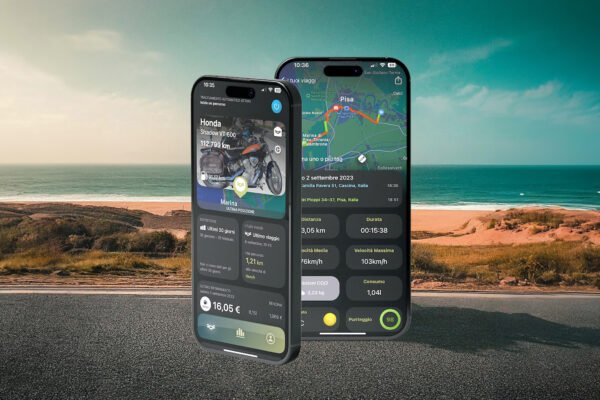
I build RideLog, an app for riders that tracks trips, fuel and maintenance and lets people share routes with each other. It is worth saying plainly what it does and does not do with everything above.
It does not tell you what category your machine is in. No app can: that is on the registration document, and the whole point of this article is that the document is the only authority.
What it does do is the part that comes after. RideLog supports motorcycles and scooters, and it is multi-vehicle, so a 50 cc commuter and a big bike live side by side in the same app with separate histories. It detects rides automatically from the phone’s motion sensors and GPS rather than asking for a start button, it logs fill-ups so the fuel consumption figure you end up with is the real one from your own riding rather than a type-approval number, and it holds the maintenance and expiry reminders — service, tyres, insurance — that a small machine needs just as much as a large one.
The data stays on the phone. There are no servers, no cloud account and no third parties, and it works offline, which on a 45 km/h machine with a phone in a pocket is more relevant than it sounds.
Download RideLog for free if you want the fuel and maintenance history of your own bike rather than somebody’s brochure figure.
Frequently asked questions
What is the difference between a moped and a scooter?
A moped is a legal category defined by numbers: in the European Union and Britain, up to 50 cm³, up to 45 km/h of design speed and up to 4,000 watts; in Washington and California, up to 50 cc and up to 30 mph. A scooter is a body style — step-through frame, floorboard, engine under the seat — with no legal definition in the European type-approval regulation, the European licence directive or the American federal safety standards. Depending on its numbers and on where you are riding it, a scooter can be either one.
What is a moped, exactly?
In European law it is an L1e vehicle that is not a powered cycle: an engine capacity of 50 cm³ or less if it burns petrol, a maximum design speed of 45 km/h or less, and 4,000 watts or less of continuous power, with a lower bound at 25 km/h. In Washington it is a device with a displacement not exceeding 50 cc producing no more than two gross brake horsepower and capable of no more than 30 mph on level ground. In California the definition additionally requires fully operative pedals, unless the machine is powered solely by electricity.
Is a scooter a motorcycle?
Often, yes. In European law any two-wheeler that cannot be classified as category L1e is a motorcycle, so a 125 cc scooter is a motorcycle in exactly the same class as a 125 cc naked bike. In California, a petrol scooter with no pedals falls outside the moped definition and is caught by the motorcycle definition instead, then sub-classified as a motor-driven cycle if it displaces less than 150 cc. In Washington, a 49 cc scooter is a moped and the motorcycle definition explicitly excludes mopeds.
Do you need a licence for a moped?
It depends entirely on where you are. In Washington, anyone sixteen or older with a valid driver’s licence of any class may operate a moped with no special examination. In California, the car class explicitly does not include a two-wheel motorcycle or motor-driven cycle, and a moped falls under class M2. In Britain, category AM requires compulsory basic training plus theory and practical tests from sixteen, unless you passed your car driving test before 1 February 2001. The European minimum age for category AM is fixed at 16 years.
How fast does a moped go?
The ceiling is 45 km/h of maximum design speed in the European Union and Britain, and 30 miles per hour on level ground in Washington and California. Those are certification limits rather than performance claims, so the number on a speedometer downhill proves nothing. Crossing the ceiling permanently is not tuning: it moves the machine into the motorcycle category, with a different licence and different permitted roads.
Can a moped or a scooter go on the motorway?
No, where the machine is a moped. The Highway Code states that motorways must not be used by riders of motorcycles under 50 cc (4 kW), and Washington makes operation of a moped on a fully controlled limited access highway unlawful. A larger scooter that is legally a motorcycle is not caught by either rule, which is another example of the category deciding rather than the shape.
Do mopeds need to be registered?
In both American states examined here, yes, through a dedicated route. California requires a motorized bicycle to display a special licence plate issued by the department, and Washington prohibits operating a moped on the highway unless it has been assigned a moped registration number and displays a moped permit.
Are scooters safer than motorcycles?
The American national data cannot answer that. The relevant fact sheet states that for its purposes motorcycles include mopeds, motor scooters, minibikes and pocket bikes, so scooters are inside the motorcycle totals rather than beside them, and the smallest engine-size bucket it reports is “up to 500 cc” — which puts a 49 cc moped and a 500 cc motorcycle in the same row. Any scooter-versus-motorcycle safety ratio drawn from that source is separating something the source does not separate.
What is the difference between a moped and a motorcycle?
The same three numbers, applied as a test. Under 50 cm³, under 45 km/h of design speed and under 4,000 watts, all at once, and the machine is a moped; exceed any single one of them and European law classifies it as a motorcycle, defined precisely as a two-wheeler that cannot be classified as category L1e. Britain writes the same line from the other side: a motor bicycle is a two-wheeler with a maximum design speed exceeding 45 kilometres per hour or a cylinder capacity exceeding 50 cubic centimetres.
Whichever of the two ends up in your garage, the running costs are yours to measure rather than to guess: download RideLog for free and let the trips, the fill-ups and the service reminders keep themselves.
Sources
- Regulation (EU) No 168/2013 on the approval and market surveillance of two- or three-wheel vehicles and quadricycles — Article 4 and Annex I (vehicle classification).
- Directive 2006/126/EC on driving licences — Article 4 (categories, definitions and minimum ages).
- Road Traffic Act 1988, section 108 (interpretation), legislation.gov.uk.
- The Highway Code, rule 253 (prohibited vehicles), GOV.UK.
- GOV.UK, “Riding a motorcycle, moped or motor tricycle”: bike categories, ages and licence requirements; licences issued before 19 January 2013.
- 49 CFR 571.3 (definitions), Federal Motor Vehicle Safety Standards.
- California Vehicle Code sections 400, 405, 406, 407.5, 5030 and 12804.9.
- Revised Code of Washington 46.04.304, 46.04.330, 46.04.336, 46.20.500 and 46.61.710.
- NHTSA, Traffic Safety Facts — Motorcycles: 2023 Data, DOT HS 813 732, July 2025.