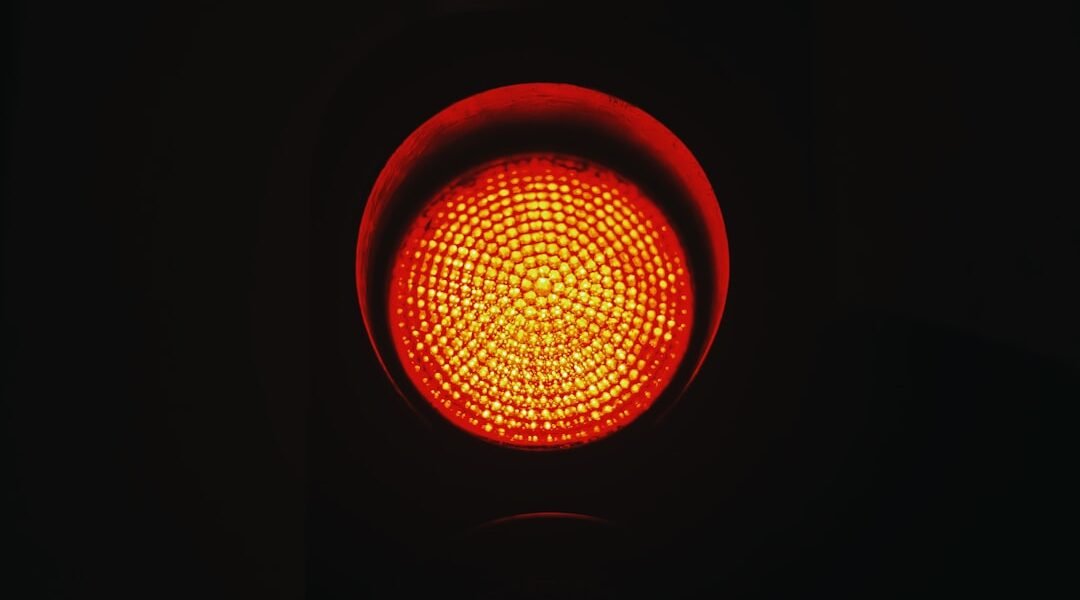
You are stopped at a red light on an empty road. Nothing is coming. The light has been red for a while now, and something in the way it is behaving tells you it is not counting down to anything — it is waiting for a car that is not going to arrive.
There is a motorcycle red light law for exactly this moment — in some states. Not in others. And the states that wrote one down disagree with each other about almost everything: how long you must wait, whether you get permission or only an excuse to use in court afterwards, and whether the detector has to have failed at all. Two of them even explain the failure with physics that the federal engineering handbook says is wrong.
So I read the documents. Eight state statutes in full, the federal manual that governs every traffic signal in the country, and the handbook the Federal Highway Administration published to tell engineers how vehicle detectors are supposed to work. This is what they actually say.
The manual that governs the traffic light does not contain the word
Every traffic signal on a public road in the United States is built to one document. This is not a figure of speech — it is a federal regulation. 23 CFR § 655.603(a):
The MUTCD approved by the Federal Highway Administrator is the national standard for all traffic control devices installed on any street, highway, or bicycle trail open to public travel in accordance with 23 U.S.C. 109(d) and 402(a).
The MUTCD is the Manual on Uniform Traffic Control Devices, and states do not get to ignore it. The same regulation gives them a deadline:
States and other Federal agencies shall adopt changes issued by the FHWA to the National MUTCD within two years from the effective date of the final rule.
Part 4 of the MUTCD is the part about traffic signals. It is the chapter that decides how the machine in front of you is designed, positioned, timed and actuated. In the 11th Edition, dated December 2023, the word motorcycle appears zero times in the whole of Part 4. The word bicycle appears 141 times.
That is not an accident of drafting. Part 4 contains a section for each road user it wants engineers to think about:
- Section 4D.02 Provisions for Pedestrians
- Section 4D.03 Provisions for Bicyclists
- Section 4D.04 Provisions for Transit Vehicles
There is no Section 4D for motorcyclists. And the manual is explicit that the naming is deliberate. Section 4B.01, the first paragraph of the whole signals chapter:
Words such as pedestrians and bicyclists are used redundantly in selected Sections of Part 4 to encourage sensitivity to these elements of “traffic.”
Redundantly, on purpose, to encourage sensitivity. The people who wrote the manual thought carefully about which road users needed to be named over and over so that nobody designing an intersection would forget them. Motorcyclists did not make the list.
Compare what a bicyclist gets, in Section 4D.03:
On bikeways, signal timing and actuation shall be reviewed and adjusted to consider the needs of bicyclists.
Shall, in MUTCD language, is a Standard — the strongest of the manual’s four levels. A motorcycle gets no equivalent sentence anywhere in Part 4, because it is never mentioned.
The handbook that does mention you says you can be trapped
The MUTCD is not the only federal document about detection. In October 2006 the Federal Highway Administration published the Traffic Detector Handbook, Third Edition (publication FHWA-HRT-06-108), which is where the engineering actually lives. In that document, motorcycles come up 21 times — and the very first thing it does is describe your problem, in a section called Detection of Small Vehicles:
A presence sensor should be able to detect a small motorcycle and hold its call until the display of a green signal. If the sensor drops a call prematurely, the motorcyclist could be trapped on the red phase. The required hold time should at least match the shortest cycle time observed at the intersection. The NEMA Standards (see appendix J) specify a minimum hold period of 3 minutes.
Trapped on the red phase. The federal handbook has a name for the thing that happens to you, and the paragraph immediately after it explains one way it happens:
Calls may be dropped prematurely in some older inductive-loop electronics units that include the ability to compensate for environmental drift, primarily due to changes in temperature and moisture. This circuitry will frequently neutralize a weak detection from a small vehicle within a period of less than a minute. Newer electronics units do not have this problem and all meet the NEMA Standards and the Type 170 Specification, which both require a minimum hold time of 3 minutes.
Read that next to the statutes and it stops being a technicality. South Carolina tells a rider to sit at the light for one hundred twenty seconds before proceeding. Virginia says two minutes. On an older detector, the handbook says, a weak call from a small vehicle can be wiped out in less than a minute — so the law can be instructing you to wait through the exact interval in which the machine forgets that you are there. You are being asked to prove your patience to a device that is under no obligation to keep listening.
Note also what the handbook is and is not. It is guidance to engineers. Nothing in it obliges any agency to buy a detector that can see you, and the MUTCD — which does oblige — never raises the subject.
It is not your weight, and two statutes say it is
Here is the folk explanation every rider has heard: the light cannot see you because a motorcycle is too light to trip the sensor. It is wrong, and the handbook says so in one sentence. Describing an experiment with a loop of wire thrown over a buried detector:
This demonstrates that it is the shorted turn, and not the wire or vehicle mass, which is important in producing the actuation.
An inductive loop is not a scale. It is an oscillating magnetic field, and what disturbs it is a closed conducting path — a shorted turn — moving through it. The handbook then explains why a bike is a bad target and a car is a good one:
These conveyances can be modeled as a vertical conducting object relative to the plane of the loop. When the cycle travels along the loop wire, eddy currents are induced in the conducting wheel rims and frame. When the cycle is directly over the loop wire, coupling between the inductive loop and the cycle is maximized.
And, of the car:
A vehicle undercarriage, on the other hand, is a horizontal target.
A car presents a broad flat sheet of metal parallel to the loop, which is the ideal shape for the field to grab. A motorcycle presents two wheel rims and a frame standing on edge, which is close to the worst shape — and it only couples well when it is sitting directly over the wire, not near it. That single sentence explains more about getting a green than every trick your riding buddies have ever told you.
The numbers are in the same document. NEMA classifies test vehicles by how much they shift the inductance of a standard six-foot loop:
Many states specify that the electronics unit must respond to a 0.02 percent change in inductance.
– Class 1: 0.13 percent (ΔL/L) or 0.12 μH (ΔL) inductance change (small motorcycle).
– Class 2: 0.32 percent (∆L/L) or 0.3 μH (∆L) inductance change (large motorcycle).
– Class 3: 3.2 percent (∆L/L) or 3.0 μH (∆L) inductance change (automobile).
A car moves the needle about 25 times further than a small motorcycle, and about 10 times further than a large one. But look at the first line again: a compliant electronics unit has to respond to 0.02 percent, and a small motorcycle produces 0.13 percent — six and a half times the threshold. On paper the sensitivity is already there. What fails is everything around it: where the loop is cut, where you stopped, and whether the box kept your call.
Even the response times are written down separately:
NEMA specifies that an electronics unit respond to the arrival or departure of a small motorcycle into and out of a 6- x 6-ft (1.8- x 1.8-m) loop within 125 ms. An automobile call must be initiated or terminated within 50 ms.
Two and a half times the time budget for the same job, because the signal is that much weaker.
Now hold that against the statutes. Kansas writes the failure into law like this:
The driver of a motorcycle or a person riding a bicycle facing any steady red signal, which fails to change to a green light within a reasonable period of time because of a signal malfunction or because the signal has failed to detect the arrival of the motorcycle or bicycle because of its size or weight, shall have the right to proceed subject to the rules stated herein.
Washington uses a better word — its statute covers a detector “inoperative due to the size or composition” of the machine, and composition is at least in the right family, since aluminium rims couple differently from steel ones. Kansas says weight, and weight is the one property the federal handbook singles out as irrelevant. It is a small thing and it changes nothing about how the statute operates. It is also a fair measure of how much engineering went into these laws. A rider who knows what a motorcycle actually weighs and where that mass sits will notice immediately that nobody checked.
Where you stop in the lane is in the handbook too
The most useful paragraph in the whole 2006 handbook is not about law at all. It is about the two feet of asphalt you choose to put your front wheel on:
Loop placement in the lane is another important consideration. Installation in the center of the lane may fail to detect the small motorcycle if the travel path is outside the quadrupole field. For example, motorcyclists waiting to turn left will usually stop on the left side of the lane and thus may be outside of the quadrupole field. Where detection is required for a left-turn lane, it is recommended that the left edge of the quadrupole be located no further than 2 ft (61 cm) from the left edge of the left-turn lane.
The federal handbook predicted, twenty years ago, exactly the habit that leaves riders stranded: sitting on the left of a left-turn lane, which is a good place for visibility and a bad place for detection, because the field may simply end before you. It is worth noticing which manoeuvre the handbook chose for its example. The left turn across traffic is also the single crash type that dominates fatal two-vehicle collisions involving a motorcycle, as the federal crash data quoted in the piece on riding to work every day sets out — so the lane position that hides you from the detector is a lane position you are taking for a reason.
It also explains why the fix is rare. A quadrupole loop is the pattern designed for small vehicles:
The single-wire configuration (“1-2-1” with one layer in the perimeter slots and two layers in the center slot), shown in Figure 4-23, is used for the detection of automobiles, trucks, and the larger motorcycles. A double layer design (“2-4-2”) is recommended for detecting small motorcycles and bicycles.
So the loop that sees your bike is a physically different loop from the one that sees cars — more wire, more saw cuts. The handbook prices it:
The major advantages of Option 3 are increased sensitivity for detecting bicycles and small motorcycles, coupled with its ability to reject detection of vehicles in adjacent lanes.
Construction cost is approximately 20 percent greater than for Option 1.
Twenty percent more, to see you. And when an agency tries to get the same result cheaply by cranking the sensitivity of a normal loop instead, it buys a different problem:
Small-vehicle (e.g., motorcycle) detection using short inductive loops requires a high sensitivity setting on the electronics unit. However, high sensitivity will frequently cause detection of vehicles in adjacent lanes (splashover).
The same pattern shows up in the other detection technology. For magnetometer probes, the handbook gives spacing per vehicle type, and the smaller you are the more hardware the intersection needs:
– Auto, Trucks, and Buses: Install probes at 5-ft (1.5-m) intervals. Six probes per channel, maximum.
– Motorcycles (300 cubic centimeters (cc) and larger) (300 cc = 18.31 cubic inches)): Install probes at 4-ft (1.2-m) intervals. Four probes per channel, maximum.
– Motor Bikes (70–300 cc) (4.27–18.31 cubic inches): Install probes at 3-ft (0.9-m) intervals. Three probes per channel, maximum.
– Bicycles: Install probes at 3-ft (0.9-m) intervals. Two or three probes per channel.
Note that the handbook splits two wheels into two classes at 300 cc, and gives the smaller class the same treatment as a bicycle — which is roughly where the line between a moped and a scooter sits in the vehicle codes as well, for entirely unrelated reasons.
And one sentence that tells you the profession has thought about the consequences:
Some traffic engineers have concerns about liability because small vehicles are not detected throughout the detection zone.
Six statutes, six different answers
Here is where the law stops being uniform. These are the six statutes I was able to read in full, and no two of them work the same way.
| State | What it gives you | How long you must wait | Must the detector have failed? |
|---|---|---|---|
| Washington (RCW 46.61.184) | Permission to proceed | One cycle of the signal | Yes — and believing it failed is not enough |
| Virginia (§ 46.2-833(B)) | Permission to proceed | Two complete cycles or two minutes, whichever is shorter | No |
| South Carolina (§ 56-5-970(C)(5)) | Permission to proceed | 120 seconds | No |
| Kansas (K.S.A. 8-1508(c)(4)) | A right to proceed | “a reasonable period of time” | Yes — malfunction or non-detection |
| Missouri (RSMo § 304.285) | An affirmative defence in court | “an unreasonable time” | Yes, “apparently” |
| Minnesota (§ 169.06 subd. 9) | An affirmative defence in court | “an unreasonable time” | Yes, “apparently” |
Two of them do not ask about detection at all. South Carolina is the plainest text in the group:
Notwithstanding any other provision of law, if a driver of a motorcycle or moped, or a bicycle rider, approaches an intersection that is controlled by a traffic-control device, the driver may proceed through the intersection on a steady red light only if the driver or rider, as the case may be:
(a) comes to a full and complete stop at the intersection for one hundred twenty seconds; and
(b) exercises due care as provided by law, otherwise treats the traffic control device as a stop sign, and determines it is safe to proceed.
Two conditions. Nothing about detectors, nothing about malfunctions. Sit for two minutes, treat it as a stop sign, go. Virginia is nearly as generous and more precise about the clock:
Notwithstanding any other provision of law, if a driver of a motorcycle or moped or a bicycle rider approaches an intersection that is controlled by a traffic light, the driver or rider may proceed through the intersection on a steady red light only if the driver or rider (i) comes to a full and complete stop at the intersection for two complete cycles of the traffic light or for two minutes, whichever is shorter, (ii) exercises due care as provided by law, (iii) otherwise treats the traffic control device as a stop sign, (iv) determines that it is safe to proceed, and (v) yields the right of way to the driver of any vehicle approaching on such other highway from either direction.
“Two complete cycles or two minutes, whichever is shorter” is a rider-friendly piece of drafting: at a fast-cycling light you are not stuck for the full two minutes, and at a light that never cycles at all the two-minute clock still releases you.
Washington is the opposite. It grants permission and then takes away the thing you would actually need in front of a judge:
It is not a defense to a violation of RCW 46.61.050 that the operator of a bicycle, moped, or motorcycle proceeded under the belief that a traffic control signal used a vehicle detection device or was inoperative due to the size or composition of the bicycle, moped, or motorcycle when the signal did not use a vehicle detection device or that any such device was not in fact inoperative due to the size or composition of the bicycle, moped, or motorcycle.
Translated: if you wait a cycle, decide the loop cannot see you, and go — and it turns out the intersection was on a fixed timer with no detector at all, or the detector was working fine — your good-faith reasoning is worth nothing. You were required to be right about a piece of buried infrastructure you cannot see, in a state whose own statute admits the machine may be inoperative.
A permission and a defence are not the same document
Missouri and Minnesota belong to a different family, and the difference matters more than the waiting time.
Missouri’s section is titled “Red light violations by motorcycles or bicycles, affirmative defense, when”, and it reads:
Any person operating a motorcycle or bicycle who violates the provisions of section 304.281 or section 304.301 by entering or crossing an intersection controlled by a traffic control signal against a red light shall have an affirmative defense to that charge if the person establishes all of the following conditions:
(1) The motorcycle or bicycle has been brought to a complete stop;
(2) The traffic control signal continues to show a red light for an unreasonable time;
(3) The traffic control is apparently malfunctioning or, if programmed or engineered to change to a green light only after detecting the approach of a motor vehicle, the signal has apparently failed to detect the arrival of the motorcycle; and
(4) No motor vehicle or person is approaching on the street or highway to be crossed or entered or is so far away from the intersection that it does not constitute an immediate hazard.
An affirmative defence is not permission. In South Carolina you did nothing wrong. In Missouri you committed the violation and you are allowed to argue your way out of it afterwards, having established all four conditions — including that the wait was “unreasonable”, a word the statute never defines, and that the signal “apparently” failed, about a device you have no way of inspecting. Then the statute closes the door on everything else:
The affirmative defense of this section applies only to a violation for entering or crossing an intersection controlled by a traffic control signal against a red light and does not provide a defense to any other civil or criminal action.
Which is the sentence that matters if the reason you are reading this is a crash rather than a ticket. The defence covers the red-light charge and nothing else.
Minnesota’s subdivision 9 carries the same four conditions in the same order, with the same words — “unreasonable time”, “apparently malfunctioning”, “apparently failed to detect”. Two legislatures, a thousand miles apart, working from the same model text. Which makes the divergence elsewhere more striking, not less: when states copied, they copied exactly; when they drafted their own, they agreed on nothing.
The states with no rule at all
Then there are the states where none of this exists, and the biggest motorcycling market in the country is one of them. California — the state that made lane splitting lawful, and whose riding culture is the most permissive in the nation — gives a motorcyclist nothing at a red that will not change. Vehicle Code § 21453(a):
A driver facing a steady circular red signal alone shall stop at a marked limit line, but if none, before entering the crosswalk on the near side of the intersection or, if none, then before entering the intersection, and shall remain stopped until an indication to proceed is shown, except as provided in subdivision (b).
Subdivision (b) is the right-turn-on-red rule, and nothing else. There is no motorcycle, moped or bicycle anywhere in the section. Florida reads the same way, in § 316.075(1)(c)1:
Vehicular traffic facing a steady red signal shall stop before entering the crosswalk on the near side of the intersection or, if none, then before entering the intersection and shall remain standing until a green indication is shown; however:
The exceptions that follow are, again, only right turn on red and the one-way-to-one-way left. Remain standing until a green indication is shown — with no clause about what happens when the green indication is never going to come.
I want to be careful here about what I am and am not claiming. I read eight statutes in full because those were the eight official texts my machine could actually reach; more than a dozen state legislature sites refused the connection or blocked the request outright. I am not telling you how many states have a rule of this kind, and I would not trust an article that gave you a tidy number without showing you the texts. Look up your own state’s traffic-signal section before you rely on any of this. The six texts above are enough to prove the point that matters: there is no national answer to this question, and the differences are not cosmetic.
One more thing every one of the six has in common: they were all written for bicycles as well as motorcycles. Not one of them is a motorcycle law. The rider gets the exemption by riding next to the bicycle in the sentence — the same bicycle the MUTCD names 141 times and the motorcycle not once.
What I actually do at a light that will not change
None of the above is riding advice, so here is the part that is. It comes straight out of the handbook rather than out of folklore.
- Stop on the wire, not near it. The coupling is maximised when the machine is directly over the loop wire. If you can see the saw cuts — a rectangle, or a rectangle with a figure-eight down the middle — put a wheel on the line itself, not in the middle of the box.
- In a left-turn lane, do not drift left. That is the exact habit the handbook flags, and it is the exact place where the field is most likely to end before you do.
- Put the bike’s metal where the field is. The eddy currents are induced in the rims and the frame, so leaning the machine slightly over the wire does more than shifting your own body weight, which the loop cannot see at all.
- Give it a full cycle before you conclude anything. Half the intersections that feel dead are simply running a long phase for the cross street.
- Hold the bike properly while you wait. Feet down, in gear, front brake covered — the stationary discipline that the basics of riding turn into habit is what lets you move the instant the phase changes, or the instant something behind you does not slow down.
- Then obey your state. Where a statute exists, its clock and its conditions are the whole of your protection, and in half the states I read the protection is only a defence you have to argue later. Where no statute exists, treating it as a stop sign is a decision to break the law and hope, and the defensive-riding habits that keep you alive at an intersection are worth more than two saved minutes.
The unglamorous move — the one that always works and that no legislature had to authorise — is to wait for a car. A car is a horizontal target with a 3.2 percent inductance signature, and it will call the phase for both of you.
Where RideLog fits, and where it does not
Straight answer first: it does not fix this. RideLog reads nothing from the bike and nothing from the road. It has no idea what a traffic light is doing, cannot tell whether an intersection has a detector, and will never turn one green.
What it does is remember the roads you actually ride. Trip detection starts on its own from the phone’s motion sensors and GPS, so every commute and every Sunday loop ends up recorded without you pressing anything, and each route is there to look at again afterwards. The dead intersection on your way to work is not a national statistic — it is one specific junction on one specific route, and the same is true of the three others you have learned to approach differently. That is route knowledge, and it is the kind of thing riders pass to each other: RideLog’s community side exists so a route you know can be shared with other riders nearby, photographs and all.
The rest of the app is the ordinary bookkeeping a bike generates — fuel-ups with litres, cost and odometer so the real consumption and cost per mile come out on their own, service and insurance reminders per vehicle, statistics by week, month and year, and PDF or CSV export whenever you want the data out. All of it stays on the phone: no cloud, no server, no third party, and it works offline where the roads are good and the signal is not. It is free to start, and you can download it here.
What it will not do is tell you that the light ahead cannot see you. Nothing will. That one is on the wire in the asphalt and the statute in your state.
Frequently asked questions
Can a motorcycle legally go through a red light?
In some states, under conditions, yes — and the conditions are not the same in any two of them. South Carolina lets a rider proceed after a full stop of one hundred twenty seconds, treating the signal as a stop sign. Virginia requires two complete cycles or two minutes, whichever is shorter. Washington requires one cycle and that the detector actually be inoperative. In California and Florida the statutes contain no such provision at all: the rule is to remain stopped until a green indication is shown.
What is a “dead red” law?
It is the informal name for a statute that lets a motorcyclist or cyclist proceed through a signal that will not turn green, usually after a fixed wait. The formal titles are duller and more revealing — Washington calls its section “Bicycle, moped, or street legal motorcycle at intersection with inoperative vehicle detection device”, and Missouri and Minnesota call theirs an affirmative defence rather than a permission.
Is a “dead red” law the same as permission?
No, and the difference decides what happens to you. A permission statute means no violation occurred. An affirmative defence — the form Missouri and Minnesota use — means the violation occurred and you may argue your way out of it by establishing every one of four conditions, including that the wait was “unreasonable” and that the signal “apparently” failed to detect you. Missouri’s text is also explicit that the defence applies to the red-light charge only and to no other civil or criminal action.
Why do traffic lights not detect motorcycles?
Not because of weight. The FHWA’s Traffic Detector Handbook states that “it is the shorted turn, and not the wire or vehicle mass, which is important in producing the actuation”: an inductive loop reacts to a closed conducting path moving through its field, and a motorcycle presents its rims and frame as a vertical target while a car’s undercarriage is a broad horizontal one. NEMA’s test classes put a small motorcycle at a 0.13 percent inductance change against 3.2 percent for an automobile. Loop geometry, loop placement in the lane, and electronics that drop a weak call do the rest.
Where should I stop to be detected?
Over the loop wire rather than in the middle of it, since the handbook says coupling is maximised when the machine is directly over the wire, and — in a left-turn lane — not on the far left, which is the exact case the handbook singles out as likely to fall outside the detection field.
Does the federal government require signals to detect motorcycles?
No. The MUTCD is the national standard for traffic control devices under 23 CFR § 655.603, and in Part 4, which covers traffic signals, the word “motorcycle” does not appear at all. The manual has sections headed Provisions for Pedestrians, Provisions for Bicyclists and Provisions for Transit Vehicles, and none for motorcyclists. The Traffic Detector Handbook, which does discuss motorcycle detection at length, is guidance to engineers and not a mandate.