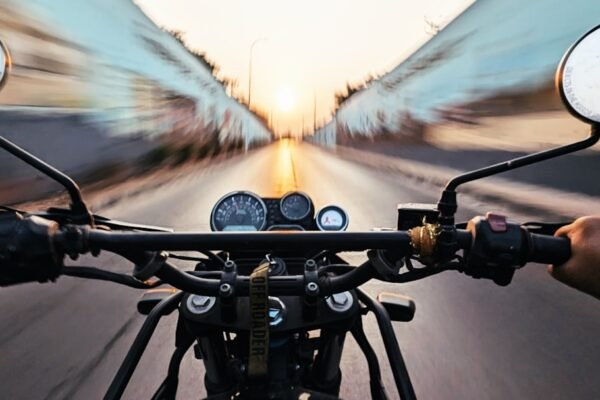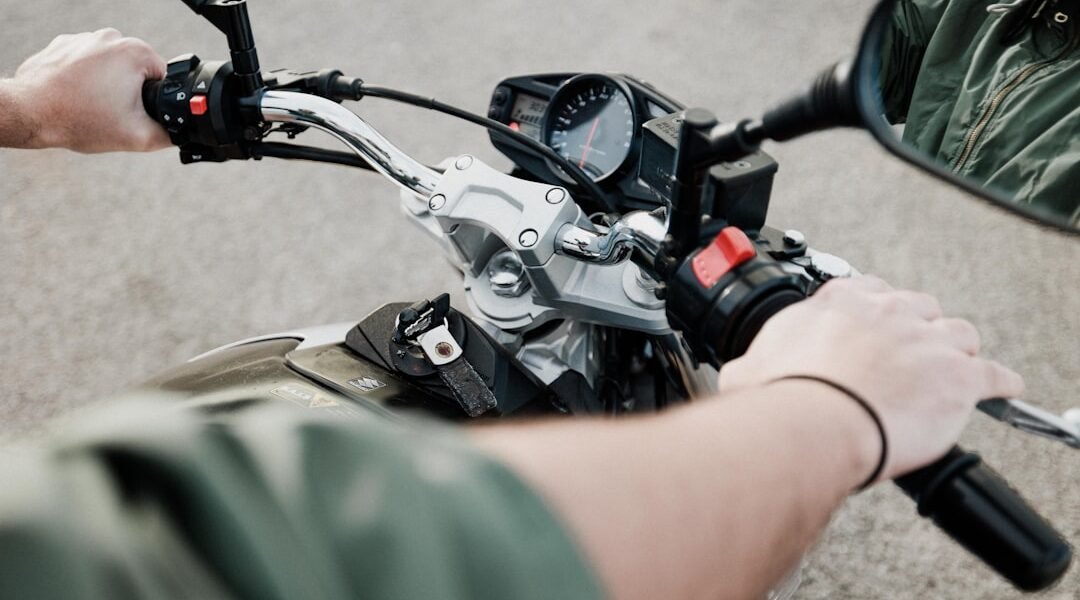
Ask five riders what an automatic motorcycle is and you get five machines: a twist-and-go scooter, a Honda with paddles behind the left grip, a Super Cub that still has a gear pedal, an electric bike with nothing to shift at all, and a sports bike whose clutch lever is still there but no longer needs squeezing. All five are sold as automatic. Only one of them is automatic in the sense most people mean.
That would be a harmless vocabulary problem, except that in Europe the word is about to acquire teeth. A directive adopted in October 2025 replaces the definition that has decided this question since 2006, and the new one turns on a single physical fact: whether there is a clutch lever that has to be operated. Everything that fails that test is automatic, and taking a riding test on it can put a code on the licence that follows the rider around.
So this is an article about seven mechanisms and one sentence. I went to the regulations and to the manufacturers’ own technical pages rather than to the reviews, and a few things came back that I did not expect — including the reason the word “scooter” exists in American federal law at all.
Seven ways to ride without a clutch lever
There is no single thing called an automatic motorcycle. There are at least seven different engineering answers to the same rider complaint, and they automate different parts of the job. Honda’s own technology Q&A walks through most of the history, which is convenient, because Honda built most of it.
1. The automatic centrifugal clutch (1958)
The oldest answer, and still the most widely produced. Honda dates it precisely:
In 1958, Honda developed an automatic centrifugal clutch, introduced on the C100 Super Cub (50cc), which allowed riders to start and change gears without requiring manual clutch operation.
What it automates: the clutch, and only the clutch. The gearbox is a conventional sequential box and the rider still selects gears with the left foot. There is no clutch lever on the handlebar, because centrifugal weights do the engaging as revs rise. A Super Cub, most small underbones, and a great many trail and kids’ bikes work this way. It is the configuration that annoys people who like categories: no clutch lever, but a gear pedal, and the rider still has to decide which gear.
2. The hydraulic ones (1963 and 1977)
Two milestones in the same family — fluid instead of friction plates:
In 1963, the Juno M (125cc) scooter was the first ever equipped with a continuously variable hydraulic transmission.
In 1977, the large-displacement (750cc) Honda EARA sports bike featured a Hondamatic automatic transmission with a torque-converter like that used for cars.
These are the true car-style automatics, and they are also the reason so many riders assume an automatic motorcycle must feel soggy. A torque converter slips by design. Honda tried it, and did not repeat it on a large motorcycle for thirty years.
3. The belt CVT (1980, and every scooter since)
The Honda TACT (50cc) released in 1980 was Honda’s first scooter equipped with the V-Matic belt drive system, which integrated drive and gear change operations, and later became the standard for simple, continuously variable transmissions (CVT).
This is the twist-and-go: two variable-diameter pulleys, a belt between them, a centrifugal clutch at the back. No gears at all in the countable sense — a continuous range of ratios. It is by far the most common automatic on two wheels, and Honda is blunt about how the market really looks:
Today, most of the automatic systems designed for motorcycles are continuously variable transmissions (CVT) similar to those used by scooters, etc.
If the machine you are thinking of has a step-through frame and a floorboard, this is almost certainly what is inside it. Where that leaves it legally is a separate question, and one I went into at length in the piece on what actually separates a moped from a scooter.
4. The automated manual transmission (2006, and again in 2024)
Take an ordinary motorcycle gearbox, leave it exactly as it is, and bolt on two actuators — one to work the clutch, one to move the shift spindle. Yamaha shipped the first one in 2006 and the current one in 2024:
Since developing and commercializing the world’s first automated manual transmission system for motorcycles in 2006 with the Yamaha Chip Controlled Shift (YCC-S), Yamaha Motor has continued to develop the base system
The 2024 system, Y-AMT, is described in Yamaha’s own release with unusual precision about what has been removed:
Y-AMT is a newly developed automated manual transmission that does away with the clutch lever and shift pedal. By consolidating shift operations into a lever on the handlebars, it allows for more intuitive gear changes.
And about what has not been touched:
Gear changes in manual transmission motorcycles are performed by operating the clutch with the left hand and shifting with the left foot. Y-AMT automates gear changes by having actuators perform these actions. As the mechanism replaces rider operation without making any major changes to the base manual transmission, the direct and satisfying shifting feel that manual transmissions are loved for is retained.
That is the whole idea in three sentences: the transmission is the manual one. The hands and feet have been replaced by motors.
5. The dual clutch transmission (2010)
Honda’s answer, and the one most people mean when they say a big automatic motorcycle:
In 2010, Honda introduced the world’s first dual clutch transmission (DCT) in a motorcycle
The claim carries a footnote — “As of June 2010 (based on Honda research)” — which is the sort of hedge a company adds when it wants the record to be checkable. The mechanism:
A Dual Clutch Transmission is a transmission in which clutch and shift operations are automated, while maintaining the structure of manual transmission with its advantages such as direct-feel acceleration.
One clutch pack carries the odd gears and starting, the other the even ones, so the next ratio is already spinning before the change happens. And there are two modes, which matters enormously for what follows:
There are two gear shifting modes: the AT mode, which automates shifting operation, and the MT mode, which allows the rider to select a gear of their choice at any time.
6. The automated clutch, and nothing else (2024)
Honda’s newest system does the opposite of the DCT. It leaves the gearbox and the gear pedal alone and automates only the lever:
Honda E-Clutch is an electronic control technology that automatically controls clutch operation without the need for the rider to operate the clutch lever, enabling smooth starting and gear shifting.
With an asterisk attached to that very sentence on Honda’s page:
Gear shift pedal operation is required to change gears.
So on an E-Clutch bike the rider still changes gear with the left foot, exactly as before, and simply never touches the lever — which is still fitted, and still works. Honda is emphatic about which side of the line this sits on:
In comparison, Honda E-Clutch only automates the clutch operation, making it a manual transmission system with the rider always in control of gear shifting. In this way, the clutch and transmission mechanisms are the same as on conventional manual transmission motorcycles.
Hold on to that phrase — “a manual transmission system” — because a piece of European law is about to disagree with it. And note what it implies for maintenance: the cable, the free play and the wear are still there, which is the whole subject of motorcycle clutch adjustment.
7. No gearbox at all
The seventh case is the one none of the technical pages above describes, because it is not a transmission technology at all: an electric motorcycle with a single reduction has no clutch to automate and no ratio to select. It is the only one of the seven where the question “is it automatic?” has no mechanical answer, only a legal one — and, as it happens, the law has to give it one anyway.
What the same company calls its own two systems
Put Honda’s two 2024-era descriptions side by side and the vocabulary problem becomes concrete. The DCT Q&A asks the direct question and answers it:
Yes, but with a difference. Honda’s Dual Clutch Transmission utilizes a computerized electro-hydraulic control system to switch between the gears of a conventional six-speed transmission.
The E-Clutch page, describing a bike where the lever is present but unused, calls the result “a manual transmission system”. So the same manufacturer, in the same year, sells one machine it calls an automatic with a difference and another it calls a manual — and the physical difference between them, from the rider’s hands, is which of the two things has been removed: the shifting, or the squeezing.
There is one more Honda detail worth recording here, because it undoes a tidy story. The DCT Q&A says flatly that a foot pedal is impossible:
As the transmission cannot be mechanically shifted by foot, no shift pedal is provided.
Then adds, in a note underneath:
A foot shifter kit is also optionally available for some models in some countries.
And the technology page confirms it, twice. For the NC750S and NC750X: “Shifting is possible by foot as well as by hand.” For the Africa Twin: “Shift operation is possible by left foot just like a normal manual transmission vehicle.” What the accessory adds is not a mechanical linkage — the shift spindle is turned by a motor either way:
In a normal manual transmission, the shift spindle is rotated by operating the shift pedal on the left foot, and the gears are slid through the shift drum and shift fork, but in a dual clutch transmission, the shift motor takes on this role.
So you can buy, from the manufacturer, a pedal that puts the gearshift back under your left foot on an automatic motorcycle. It is a switch shaped like a lever. Which is a fine engineering joke until a rulebook has to decide what that machine is.
The sentence that decides it in Europe
Directive (EU) 2025/2205, adopted on 22 October 2025, replaces the driving licence directive that has been in force since 2006. Buried in Annex II, in the part about the practical test, is the definition everything else hangs on:
The driving of a vehicle with manual transmission shall be subject to the passing of a skills and behaviour test taken on a vehicle with manual transmission. ‘Vehicle with manual transmission’ means a vehicle in which a clutch pedal (or lever operated manually for categories A, A2 and A1) is present and must be operated by the driver when starting or stopping the vehicle and changing gears.
Read what it does not say. It does not describe an automatic. It describes a manual, and it does so with two conditions joined by “and”: the lever is present, and it must be operated — for starting, for stopping, and for changing gear. Miss either condition and the vehicle is not a manual.
And the sentence immediately after it
The next line is a residual clause, and it is the most consequential sentence in the whole file:
Vehicles that do not meet the criteria laid down in point 5.(1), point (a), shall be considered to have automatic transmission.
There is no third box. A motorcycle is either a manual by that definition or it is an automatic by default. A twist-and-go scooter: no lever, automatic. A Super Cub: no lever, automatic, gear pedal notwithstanding. A DCT: no lever, automatic, even in MT mode with the rider choosing every gear on the paddles. An electric motorcycle: no lever, automatic, and the sentence never has to mention electricity — it asks about a lever.
And the E-Clutch? The lever is present. Whether it “must be operated” depends on a setting, because Honda says so:
The system can be turned on or off. When the system is on, it automatically controls clutch operation and no clutch lever operation is required from the rider (excluding manual mode as explained below). Only throttle operation is required when starting, only gear shift pedal operation is required for gear shifting, and clutch lever operation is not required when stopping. When the system is off, it operates like a normal manual transmission, which requires clutch lever operation in all riding states (starting, gear shifting, and stopping).
A definition written around the words “present and must be operated” meets a motorcycle where the second half is a switch on the handlebar. I am not going to tell you how each national examining authority will resolve that, because none of them has had to yet — the directive is not applied until late 2029. But it is a real question, it has a real consequence, and as far as I can tell nobody selling these bikes has raised it.
What the old rule said, and why it could not survive
The directive being replaced, 2006/126/EC, defined the same idea from the other end. In the text as adopted:
‘Vehicle with automatic transmission’ means a vehicle in which the gear ratio between the engine and the wheels can be varied by use only of the accelerator or the brakes
That is a definition about behaviour, not hardware, and it has two visible problems on a modern motorcycle.
The first is the DCT in MT mode, where the ratio is varied by neither the accelerator nor the brakes but by a thumb switch. The second, and worse, is the electric motorcycle, where the gear ratio between motor and wheel cannot be varied at all — not by the accelerator, not by the brakes, not by anything. Read strictly, the 2006 definition does not describe an electric bike as an automatic. It does not describe it as anything.
Notice, too, how closely Yamaha’s marketing copy for the AT mode tracks the old legal text, twenty years later:
In AT mode, the optimum gear is automatically selected according to vehicle speed and throttle opening, so the rider only has to operate the throttle and brakes.
Accelerator and brakes. The engineers and the legislators reached the same sentence from opposite directions, which is usually a sign that the sentence was right for its era and has run out of era.
Code 78, and what a restricted licence actually stops you doing
The consequence is a two-digit code. Annex I of the new directive keeps it unchanged from the old one:
78 Restricted to vehicles with automatic transmission
And the operative words, in the same passage as the definition:
if an applicant takes the test of skills and behaviour on a vehicle with automatic transmission this shall be recorded on any driving licence issued on the basis of such a test with the relevant Union code set out in Annex I, Part E. Driving licences with this indication shall be used only for driving vehicles with automatic transmission.
Which is worth restating in plain terms, because it is the practical point of this entire article for anyone learning to ride in Europe. Pass your motorcycle test on a scooter, on a DCT, or on an electric bike, and the licence you receive does not let you ride a conventional motorcycle. Not a smaller one, not a borrowed one, not on a Sunday. The restriction is on the licence, not on the bike you happened to hire.
For anyone riding in the United States this is unfamiliar, and I will come back to why. But it is not exotic in Europe: it is the same code that has ridden along on car licences for two decades, applied to two wheels.
The seven hours that did not exist before
Here is the part of the new directive that is genuinely new, and good news. Under the old text, the only way to shed the restriction was to sit the whole practical test again on a manual. The 2025 directive adds a shortcut, and it names motorcycle categories explicitly:
The Union code described in the second subparagraph shall not be recorded on, or shall subsequently be removed from, a category A1, A2, A, B1, B or BE driving licence if the applicant or holder passes a dedicated test of skills and behaviour or completes a dedicated training, which may occur before or after the test of skills and behaviour on a vehicle with automatic transmission.
The training route has a floor, a subject and a vehicle requirement:
The duration of the training shall be at least 7 hours.
Vehicles used for the training or the test covered by this point shall be with manual transmission and shall fall within the category of the driving licence for which the participants have applied.
Seven hours on a manual bike of the right category, and the code either never appears or comes off. It can be done before the test as well as after, which means from 2029 a rider can legitimately learn on an automatic, sit the test on an automatic, and still walk away unrestricted. That option does not exist today.
The exam itself changes shape
Two lines in the motorcycle test specification are conditional on the machine, and reading them tells you what an automatic test actually leaves out. On the slow-speed manoeuvres:
If the test is taken on a motorcycle with manual transmission, it shall be in combination with handling of the clutch.
And on the faster ones:
If the test is taken on a motorcycle with manual transmission, one manoeuvre must be performed in second or third gear; this shall allow competence to be assessed in technique of changing gears
So the examiner is not merely observing a different bike. Two assessed competences — clutch handling and gear changing — are simply not exercised. That is a coherent reason for the restriction to exist, and it is also, in one sentence, the reason the seven-hour route makes sense: the training has to put back precisely what the test could not measure. If you want the underlying skill described properly rather than legally, it is the same friction-zone material I walked through in how to ride a motorcycle.
One more small thing worth flagging for anyone who reads old paperwork. The code list itself was quietly rewritten. The 2006 annex listed adaptation code “10.02 Automatic transmission”. The 2025 annex lists “10.02. Automatic selection of gear ratio”. A vehicle-adaptation code that used to name a component now names a function — which is the same move the main definition makes.
The dates, so nobody panics early
The directive is adopted and published. It is not yet the rule anyone lives under.
| Milestone | Date |
|---|---|
| Member States adopt and publish national measures | by 26 November 2028 |
| Member States apply those measures | from 26 November 2029 |
| Directive 2006/126/EC repealed | 26 November 2029 |
Until that last date, the old definition — accelerator or brakes — is the one in force. Anyone taking a motorcycle test in Europe between now and then is being judged by a rule written in 2006, and anyone planning to take one on an automatic in 2030 should read the paragraph about the seven hours before booking anything.
What American federal law says about your clutch: almost nothing
Now the contrast, and it is sharper than I expected. The United States regulates the motorcycle, not the rider’s transmission history.
The relevant standard is FMVSS No. 123, Motorcycle controls and displays. Its scope:
This standard specifies requirements for the location, operation, identification, and illumination of motorcycle controls and displays, and requirements for motorcycle stands and footrests.
The whole structure is conditional. Everything in the main control table applies only to equipment the machine actually has:
If any item of equipment listed in Table 1, Column 1, is provided, the control for such item shall be located as specified in Column 2, and operable as specified in Column 3.
Which means a motorcycle with no clutch lever and no gear pedal has nothing to comply with in those rows. It is not exempted, it simply has no such items.
Then there are the counts, which I ran on the text of the standard as printed in the 2024 Code of Federal Regulations. The word “transmission” appears zero times. The word “clutch” appears exactly twice, and both times inside the phrase “automatic clutch”. The manual clutch — the thing every rider in the country learns first — is never named in the text at all. It lives in Table 1, which the CFR prints as an image.
There is one substantive rule that turns on the clutch, and it is about brakes:
If a motorcycle with an automatic clutch other than a scooter is equipped with a supplemental rear brake control, the control shall be located on the left handlebar. If a scooter with an automatic clutch is equipped with a supplemental rear brake control, the control shall be on the right side and operable by the operator’s right foot.
That is the entire federal interest in whether your clutch is automatic: where an extra rear brake control may sit. Compare that with a European code that decides which motorcycles your licence permits, and you have two legal systems that have taken the same mechanical fact and put it in completely different drawers.
Licensing in the United States is state law, and I am not going to pretend to have read fifty rulebooks. What I can say is that the federal standard treats an automatic clutch as a fact about the vehicle, while European law treats it as a fact about you.
Why the word “scooter” exists in American federal law
That brake rule quotes a word that has no business being in a federal safety standard, and tracking down why turned out to be the best story in the file. FMVSS 123 contains a definition:
Scooter means a motorcycle that: (1) Has a platform for the operator’s feet or has integrated footrests, and (2) Has a step-through architecture, meaning that the part of the vehicle forward of the operator’s seat and between the legs of an operator seated in the riding position, is lower in height than the operator’s seat.
I should be straight about something here. When I wrote about mopeds and scooters I said the word “scooter” carried no legal weight anywhere I had checked, and pointed at state vehicle codes to prove it. That was too strong. It carries weight in exactly one American place, and this is it — a federal motor vehicle safety standard, defining the word so that a brake rule can apply differently to one shape of machine.
The reason is the automatic transmission. The final rule that created the definition, published on 30 August 2005, sets out the problem in the agency’s own words. First, what an automatic clutch is:
FMVSS No. 123 also states that, if a motorcycle has an “automatic clutch” (i.e., a transmission which eliminates the need for a clutch lever) and a supplemental rear brake control (in addition to the right foot control), the supplemental control must be located on the left handlebar.
Then, why the rulemaking happened at all:
These petitions have come from manufacturers of scooters with automatic transmissions and handlebar-mounted brake controls, which is a common arrangement for scooters sold in Europe, Asia, and other parts of the world outside of the United States.
but were prevented from doing so by the requirement that motorcycles be equipped with a right foot control for the rear brake.
European automatic scooters could not be sold in America, because American law demanded a right-foot rear brake and a twist-and-go has no left foot doing anything else. The first manufacturer through the door was Italian:
For the rear brakes, Aprilia’s Leonardo 150 motorcycle had a left handlebar control, not the right foot control specified in FMVSS No. 123.
And the reason a 150 could not simply be waved through is a definition from elsewhere in the rulebook — a “motor-driven cycle” is allowed the left-hand rear brake, and a motor-driven cycle is:
A motorcycle with a motor that produces five brake horsepower or less
The Leonardo made more than five horsepower. Six brake horsepower is what stood between a European scooter and the American market, and the way through it, eventually, was to write the shape of the vehicle into federal law.
Honda told the regulator in 2004 what it would build in 2010
The comment file on that rulemaking has a moment worth preserving. Honda argued against making the brake layout depend on the clutch, and its objection was hypothetical at the time. Making the rule turn on the presence of a clutch, it wrote, would create a condition where a single motorcycle
offered with both manual and automatic transmission would have different locations for the rear brake controls. Being similar in every other way, this difference in rear brake control location could lead to rider confusion if an individual were to ride both versions of this model.
Six years later Honda launched the VFR1200F in exactly that configuration: one model, two transmissions. And when the DCT Q&A gets round to the obvious question about controls, the answer is the 2004 comment turned into a design decision:
No, to minimize confusion, Dual Clutch Transmission models are equipped with the same right hand front brake and right foot rear brake operation used on general sports bikes.
Harley-Davidson’s comment in the same file is a period piece of a different kind:
That company does not presently sell motorcycles with a transmission without a clutch lever.
The official American rider manual has nothing to say about automatics
The Motorcycle Operator Manual published by the Motorcycle Safety Foundation is the document most state knowledge tests are drawn from, and I have used it as a source before, most recently when working out what a motorcycle actually weighs. So I counted.
The word “clutch” appears 25 times: 20 of them in the two-wheel manual, 5 in the three-wheel supplement at the back. The word “automatic” appears 5 times — and exactly one of those is in the two-wheel manual, where it is not about transmissions at all:
It’s quick and easy to check the critical components and it should be as routine and automatic as checking the weather forecast before heading out for the day.
That is the pre-ride inspection. Every other mention is in the three-wheel supplement, where an automatic appears in a list of things that make a trike unusual:
Motorcycle-type controls with the standard layout. Convenience alterations like a single brake pedal or lever control, automatic clutch, or automatic transmission.
A convenience alteration. The manual that teaches the country to ride treats the clutch lever as universal and the automatic as a modification found on three-wheelers. That is not wrong for the fleet it was written about. It is a poor preparation for a showroom where a Gold Wing, an Africa Twin, an NT1100, a Rebel 1100 and an X-ADV are all sold without a clutch lever.
Europe regulates exactly one automatic transmission, and it is not the one you would guess
The other direction produces an equally odd result. Regulation (EU) No 168/2013 is the act that sorts every two- and three-wheeler in Europe into a category — the act I had to read line by line for the piece on weight. The word “clutch” appears in it zero times. The word “automatic” appears eight times, and not one of them is about transmissions: seven are about headlights switching on by themselves, one is about how an anti-lock system modulates pressure. European type-approval law does not care whether your motorcycle has a clutch.
With one exception, and it is a good one. Annex II of the delegated regulation that fills in the construction requirements is titled “Requirements applying to powertrain tampering prevention measures”, and point 3.5 is about the variator in a scooter:
3.5. Continuous Variable Transmission (CVT) 3.5.1. CVT Transmission covers, if available, shall be fixed by means of at a minimum 2 shear bolts or be disassembled only by using special tools.
3.5.2. The CVT mechanism intended to limit the drive ratio by limitation of the effective distance between two discs shall be fully integrated in one or both discs in such a way that it is impossible to modify the effective distance beyond a limit that would result in an increase of the maximum vehicle speed of more than 10 % of this maximum permissible vehicle speed without destroying the disc system.
Shear bolts. A cover that cannot be reopened, and a variator that has to break rather than let a fifty go faster. The only automatic transmission European law regulates as a transmission is the scooter’s, and it regulates it on the assumption that the owner is going to attack it with hand tools. The scope is the moped and light quadricycle categories, which tells you exactly which fifty-cc rider the drafters had in mind.
There is one more line, elsewhere in the same regulation, that shows the drafters knew a motorcycle might have a park position. In the test procedure for stands:
The vehicle’s transmission shall be put in the ‘park’ position, if available, in the case of an automatic transmission, or the ‘neutral’ position in all other cases.
The parking brake, and other things nobody mentions
Which brings up the most practical consequence of an automatic motorcycle, and one that almost no buying guide raises. A conventional bike parked on a slope is left in gear; the compression of a stationary engine holds it. A DCT cannot be left in gear, because the clutches are disengaged when the engine is off. Honda’s answer is hardware:
All Dual Clutch models are also equipped with a manual parking brake, which should be used whenever stopped.
Every model, and “whenever stopped” — not “on hills”. If you have ridden manual bikes for twenty years, that is a new habit to build, and the failure mode is your motorcycle rolling off its side stand in a car park.
The rest of the everyday differences are smaller than the internet suggests. The brake controls are where they always were, by design. The engine still brakes, and the downshift switch still works while the machine is in Drive. What actually changes is the left hand and the left foot, and what fills the space they used to occupy is attention — which is the honest argument for these systems in traffic, and the same argument I made about commuting by motorcycle.
Does it cost fuel? Honda measured it and published the number
This is where the reviews usually reach for adjectives. Honda ran the comparison and put the result in a technical Q&A:
In comparison tests of the NC700X, the NC700X ABS and the NC700X with Dual Clutch Transmission, it was found that all three averaged about 41km per liter based on a constant speed of 60km per hour.
Three versions of one motorcycle, one steady speed, the same figure. Take it for what it is: a constant-speed comparison, not a commute, and about 41 km/l is not a number anyone will match in traffic. But it does dispose of the idea that an automatic gearbox costs you a chunk of range by construction. On a DCT the ratios are the same ratios; only the hand that selects them has changed.
The rider-level version of that claim is testable, and it is the only way to know what your own bike does. Fill up, log the litres, log the distance, and read the trend over a few tanks rather than one. That is worth doing whatever transmission you have, and it is the one measurement where an automatic is genuinely easier to compare, because the gear selection stops being a variable.
Does it cost weight? One manufacturer published that too
Yamaha gives a figure for the added hardware:
The unit’s total weight is approximately 2.8 kg and has achieves a lightweight, slim, and compact design that minimizes the impact on the original vehicle’s styling and handling characteristics.
That is the actuator package on Y-AMT, not a whole-bike delta, and I could not get comparable published curb weights out of the manufacturers’ spec pages, so I am not going to invent a number for DCT. What 2.8 kg means in practice is roughly four litres of fuel — worth knowing, and roughly nothing next to the twenty or thirty kilos that separate two motorcycles of the same class, as I found when I went through the seven official ways of weighing a motorcycle.
What actually changes when you ride one
Stripping out the marketing on both sides, here is what the sources support.
What goes away: the clutch lever, on five of the seven types. The gear pedal, on three of them. Stalling at junctions, on all of them. On a CVT, the concept of a gear.
What stays: the front brake on the right hand and the rear on the right foot, on Honda’s automatics, because Honda decided in 2004 that moving them would be worse. Engine braking. Downshifting on demand — on a DCT it happens through a switch, and the system refuses the request if the resulting revs would be dangerous. Everything about cornering, braking distance and road position, none of which cares what turns the shift spindle.
What is new: the parking brake habit. A mode switch to think about. And, in Europe from late 2029, a question on the licence application that did not use to matter.
What is unresolved: where a Honda E-Clutch sits. Honda calls it a manual transmission system. The new European definition asks whether a lever is “present and must be operated”, and on that machine the answer is a setting. I would not want to be the examiner who has to decide.
Where a ride log fits, and where it does not
I build RideLog, so let me be precise about the part of this an app can actually help with, and about the part it cannot.
It cannot tell you what transmission you have. The app does not read anything from the bike’s electronics — it has no connection to the machine at all — so it does not know whether you shifted with a foot, a paddle or nothing. There is no gear counter and there never will be, because there is nothing to count from.
What it does do is the measuring. RideLog logs rides on its own, using motion and GPS, so there is no start button to forget on the days you are still getting used to a new bike. It records fuel stops, so consumption over a few tanks becomes a trend rather than an anecdote — which is exactly the calculation Honda made at 60 km/h and you can make in the real world. It keeps maintenance deadlines per vehicle, which matters if a DCT or an automated-clutch bike has joined a garage that already contains a manual one, because the two are not on the same schedule and the service book is the only place that answer lives, a point I laboured over in the piece on what maintenance schedules actually say. And it handles several vehicles at once, which is the situation most riders trying an automatic are actually in — the new bike does not usually replace the old one straight away.
Everything stays on the phone. No account, no cloud, no server holding your movements, and it works with no signal. That is a design decision I made at the start and have not regretted.
Download RideLog free if you want the fuel and maintenance side of this measured rather than guessed.
Frequently asked questions
Is a scooter an automatic motorcycle?
Mechanically, almost always yes: a belt CVT with a centrifugal clutch, the arrangement Honda standardised with the V-Matic system in 1980 and which its own technology page still describes as the most common automatic on two wheels. Legally it depends which question you are asking. Under the new European definition it is an automatic, because there is no clutch lever to operate. In American federal law “scooter” is a defined shape — a platform for the feet and a step-through frame — and the definition exists so that a brake rule can treat it differently.
Does a Honda DCT have a gear lever?
Not as standard. Honda’s Q&A says “the transmission cannot be mechanically shifted by foot, no shift pedal is provided”, and a separate note adds that “a foot shifter kit is also optionally available for some models in some countries”. The technology page confirms the accessory for the NC750S, NC750X and Africa Twin. When fitted, the pedal does not act on the gearbox mechanically — a shift motor turns the shift spindle either way — so it is a control in the shape of a lever.
If I pass my test on an automatic, can I ride a manual motorcycle?
In Europe, no, not while the restriction is on the licence. The code reads “Restricted to vehicles with automatic transmission” and the directive says such licences “shall be used only for driving vehicles with automatic transmission”. Under the directive that applies from 26 November 2029 the restriction can be removed with a dedicated test or a dedicated training course of at least seven hours on a manual motorcycle of the same category. In the United States licensing is state law and the federal safety standard says nothing about your licence at all — it regulates the machine.
Is an automatic motorcycle slower or thirstier?
Not by construction. Honda compared three versions of the NC700X — standard, ABS and DCT — at a constant 60 km/h and reported about 41 km per litre for all three. On a dual clutch the gear ratios are the ones the manual bike already had; what changed is what selects them. Real-world figures depend on the rider far more than on the actuators, which is why measuring your own consumption over several tanks beats any published number.
What is the difference between DCT, Y-AMT and E-Clutch?
Three different amounts of automation on the same underlying gearbox. Honda’s DCT automates clutch and gear selection and has no clutch lever, with an AT mode and an MT mode on handlebar switches. Yamaha’s Y-AMT automates clutch and gear selection with two actuators on an otherwise standard transmission and “does away with the clutch lever and shift pedal”, moving shifting to a lever on the bars, with the same AT and MT choice. Honda’s E-Clutch automates only the clutch: the gear pedal stays, the clutch lever stays and still works, and the system can be switched off entirely — which is why Honda calls it “a manual transmission system”.
Do automatic motorcycles need a parking brake?
Honda’s do, and it is not optional equipment: “All Dual Clutch models are also equipped with a manual parking brake, which should be used whenever stopped.” A conventional motorcycle is parked in gear, and a dual clutch transmission cannot be left in gear with the engine off. It is the single habit most worth building in the first week.
The short version
An automatic motorcycle is not one machine, it is seven, and they automate different halves of the same job. The industry uses one word for all of them and the law is only now catching up: Europe has just replaced a definition about what varies the gear ratio with a definition about whether there is a lever you must squeeze, which quietly moves electric bikes, dual clutch transmissions and Super Cubs into the same box, and leaves at least one recent Honda sitting on the line with a switch deciding which side it falls on. America, meanwhile, asks the question only to decide where a spare brake control may go — and had to invent a legal definition of “scooter” to let Italian automatics through the door.
If you are choosing one, none of this should decide it. Ride both, then look at the licence rules that apply where you live, and build the parking brake habit on day one.
Download RideLog free — automatic trip detection, fuel and maintenance logs, several bikes at once, and nothing leaves your phone.