Search for motorcycle hand signals and the lists come back promising fifteen, twenty, thirty-five of them. Open the two documents the Motorcycle Safety Foundation actually publishes and you find fourteen — and not one of them is a turn signal.
That gap is worth understanding before your next group ride, because the signals fall into two categories that behave completely differently. Three arm positions are written into vehicle codes and mean something legally to every driver around you. The rest are a private language your group agrees on in a parking lot, and the official advice — from the same organisation that publishes the chart — is to review them before you set off, precisely because they are not universal.
The three signals that are actually law
Every state vehicle code I checked describes the same three arm positions, and both of the ones I read specify the side. California Vehicle Code section 22111 opens with it:
All required signals given by hand and arm shall be given from the left side of a vehicle in the following manner:
Then the three:
Left turn — hand and arm extended horizontally. Right turn — hand and arm extended upward. Stop signal — hand and arm extended downward.
Minnesota Statutes section 169.19, subdivision 8, describes the same three and the same side, “extending the hand and arm from and beyond the left side of the vehicle”. On a motorcycle that means the left arm, every time — which is also the arm that works the clutch, and the reason this is more awkward on a bike than in a car.
The UK Highway Code lands in the same place from a different legal system. Its “Signals to other road users” section lists three arm signals and no more: one for turning left, one for turning right, one for slowing down or stopping.
Three signals, three jurisdictions, no disagreement. These are the ones a car driver is supposed to recognise. Everything else in this article is communication inside your group, and a driver has no obligation to know any of it.
Your state may not agree with the next state
Here is the first thing the fifteen-item lists tend to flatten. Even the legal signals are not uniform.
California grants an exception on the right turn — but only to cyclists, who may extend the right hand and arm horizontally instead of raising the left. Minnesota grants the same exception and explicitly extends it to motorcyclists: a rider there may signal a right turn with the right arm held straight out to the right, which is far more legible to the car alongside than an elbow bent skyward.
Same gesture, same continent, two different legal answers. Before you adopt a habit because a blog post described it as standard, read your own state code — it takes two minutes and it is the only version that applies to you.
A hand signal is a legal signal, not a backup
Riders often assume the arm is a workaround for a broken indicator. In the statutes, it is the other way round: the arm is the primary method, and the lamp is the alternative.
Minnesota’s subdivision 7 is unusually clear about it:
The signals herein required shall be given either by means of the hand and arm or by a signal lamp or signal device of a type approved by the commissioner of public safety, but when a vehicle is so constructed or loaded that a hand and arm signal would not be visible in normal sunlight, and at night both to the front and rear of such vehicle, then the signals must be given by such a lamp or device.
Read the exception carefully. The lamp becomes mandatory only when the vehicle or its load hides the arm — the situation of a box truck, not a motorcycle. On a bike the arm is visible by construction, so a hand signal satisfies the requirement on its own.
Two practical caveats the statutes hand you for free. First, the same section requires the turn signal to be given continuously for at least the last 100 feet before turning. Try holding an arm out for 100 feet while downshifting and covering the front brake, and the theory meets the clutch lever. Second, the code separately forbids stopping or slowing sharply without signalling to the vehicle behind. If the choice is between a clean brake input with both hands and a decorative arm gesture, take the brake — and give the signal earlier next time, while you still have a free hand.
The UK Highway Code adds a restriction worth borrowing wherever you ride: arm signals are for when indicators are not used or need reinforcing, and “these signals should not be used except for the purpose described.” A turn signal recycled as a friendly wave is a signal that has stopped meaning anything.
The official group chart: fourteen signals, no turns
The Motorcycle Safety Foundation publishes the same set of hand signals twice — in the Motorcycle Operator Manual, the booklet state licensing programs use, and in a three-page Guide to Group Riding. Both charts contain fourteen signals, and they match each other item for item.
| # | Signal | How it is described |
|---|---|---|
| 1 | Single file | Arm and index finger extended straight up |
| 2 | Double file | Arm with index and middle finger extended straight up |
| 3 | Stop | Arm extended straight down, palm facing back |
| 4 | Speed up | Arm extended straight out, palm facing up, swing upward |
| 5 | Slow down | Arm extended straight out, palm facing down, swing down to your side |
| 6 | Follow me | Arm extended straight up from shoulder, palm forward |
| 7 | You lead / come | Arm extended upward 45 degrees, palm forward pointing with index finger, swung in an arc from back to front |
| 8 | Hazard in roadway | On the left, point with the left hand; on the right, point with the right foot |
| 9 | Highbeam | Tap the top of the helmet with an open palm, facing down |
| 10 | Fuel | Arm out to the side, pointing at the tank with a finger extended |
| 11 | Comfort stop | Forearm extended, fist clenched, short up and down motion |
| 12 | Refreshment stop | Fingers closed, thumb to the mouth |
| 13 | Turn signal on | Open and close the hand with fingers and thumb extended |
| 14 | Pull off | Arm positioned as for a right turn, forearm swung toward the shoulder |
Two things stand out once the list is in front of you.
There is no left turn and no right turn on it. Those live in the vehicle code, not in the group vocabulary — which makes sense, because a turn is information for everyone on the road, not for your friends.
And the manual does not call these standard. It calls them “the common hand signals”, and tells you to review them at the riders’ meeting before departure. That is the organisation that literally wrote the chart telling you the chart is a starting point for a conversation.
Where the chart collides with the law
Now put the two sets side by side, which is something the listicles never do.
The legal signal for a left turn is the left arm extended horizontally.
The group signal for slow down is the left arm extended horizontally, palm down.
The group signal for speed up is the left arm extended horizontally, palm up.
One arm position, three meanings. What separates them is the palm orientation and — in the Motorcycle Operator Manual version, though not in the wording of the Quick Tips sheet — a movement: down to your side for slow, upward for speed up. That movement is the part that actually reads at a distance. Palm angle does not, especially through a car windscreen, in gloves, at 60 mph.
The consequence is simple and worth saying out loud: the group signals are for the people who know you are riding together. When traffic is close enough to read your arm, assume it will read “left turn”, because that is the only meaning the law gave it.
The one place the two vocabularies agree completely is stop. The codes say hand and arm extended downward; the MSF chart says arm extended straight down, palm facing back. Same gesture, same meaning, understood by the group and the car behind alike. It is the one signal you never have to think twice about.
The pairs that look alike at speed
Inside the chart there are collisions too, and they explain why disciplined groups still hold a briefing.
Follow me is the arm straight up from the shoulder, palm forward. Single file is the arm straight up with the index finger extended. From three bike lengths back, through a tinted visor, in low sun, the difference is one finger.
Speed up and slow down share an arm position and differ by a palm. Double file adds a second finger to single file. Pull off borrows the right-turn arm position and adds a swing toward the shoulder — so a rider seeing only the first half sees a right turn.
None of this is a flaw in the chart. It is a consequence of running an entire vocabulary through one gloved hand while the other hand keeps the throttle. It is also exactly why both MSF documents put the pre-ride briefing before the signal list rather than after it.
What the pre-ride meeting is actually for
The Motorcycle Operator Manual is specific about the agenda: the route, the length of the riding segments, rest stops, and the locations for fuel, meals and lodging. Then one line that carries more weight than it looks:
Make sure everyone knows the route. That way, if someone becomes separated, he or she won’t have to hurry to keep from getting lost or making the wrong turn.
That is the real function of the meeting. Signals handle the small stuff — a hazard, a fuel stop, tightening into single file. The route is what stops a separated rider from riding beyond their ability to catch up, and no hand signal can transmit a route.
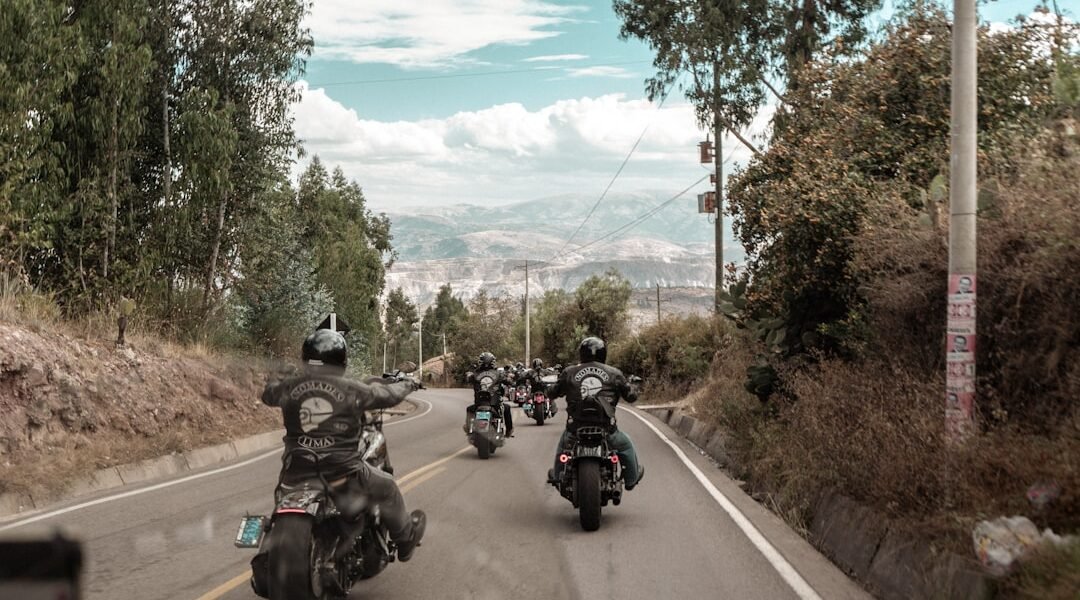
The meeting also assigns the two roles the manual treats as non-negotiable: a lead rider and a sweep rider, both experienced, with the least experienced riders placed directly behind the leader so they are never chasing the group and are always watched from behind. The Quick Tips sheet adds the group size: ideally five to seven riders, and beyond that split into sub-groups separated by a few seconds, each with its own lead and sweep.
And it states the three rules that make everything else work — no competition, no passing of other riders, no tailgating. If someone insists on riding faster, the manual’s answer is not a hand signal. It is to let them go ahead to an agreed meeting point.
Before any of that, everyone’s bike needs to be fit for the day: a group ride is a bad place to discover a soft tyre or a dragging brake, which is what the pre-ride checklist is for, and why the service schedule matters more than usual before a long day with other people depending on you.
Staggered formation, and the numbers behind it
The formation is not aesthetic. It exists to buy every rider a space cushion without stretching the group across half a mile of road.
The Motorcycle Operator Manual describes it with actual figures:
- The leader rides in the left portion of the lane.
- The second rider stays at least one second back, in the right portion of the lane.
- The third rider takes the left position again, at least two seconds behind the first.
- The fourth keeps at least two seconds from the second, and so on down the group.
Each rider therefore has roughly two seconds to the bike directly ahead in their own track, and one second of offset to the bike diagonally in front. Close enough to stay together and be seen as one object by other traffic; spread enough that nobody inherits someone else’s mistake.
The manual is blunt about the alternative: never ride directly alongside another rider in the same lane, because “there is no place to go if you have to maneuver to avoid a car or hazard in the roadway”. If you need to talk, wait until you are both stopped.
When the formation should break
Staggered is the default, not the answer to everything. Between the two documents — the manual names the first three, the Quick Tips sheet adds the last two and puts a number on the gap, at least two seconds — the situations that call for single file are:
- riding through curves
- turning
- entering or leaving freeways and highways
- poor visibility
- poor road surfaces
The logic is the same in each case: the moment a rider needs the full width of the lane to choose a line, an offset partner is a constraint rather than a companion. On a twisty road that is most corners, which is why a spirited group ride through the mountains spends more time in single file than in formation. Rain multiplies the same argument — worth reading alongside the wet weather riding techniques — and so does darkness, where the night riding guide applies to every rider in the group at once.
Intersections, passing, and the rider who drops out
Three group manoeuvres get specific treatment in the manual, and all three are places where improvisation hurts.
Intersections are called the highest-risk point for a group. On a left-turn arrow the instruction is to tighten the formation so as many riders as possible clear the light, and to make the turn single file, never side by side. Riders who do not get through stop at a safe point ahead and wait — which removes the pressure to speed up or run a red.
Passing happens one rider at a time. The leader goes first; the second moves up to the left position and then waits for a gap of their own. The manual spells out the reasoning: “Just because the lead rider passed, that does not mean that conditions haven’t changed and that it is still safe for other riders to pass.” After passing, the rider returns to the right position and opens room for the next.
A rider leaving mid-ride produces the most counterintuitive instruction in either document. The group re-forms by criss-crossing into the vacant position rather than having the column behind the gap simply move up — because moving up means passing another rider inside the lane, and MSF does not recommend it. Efficiency loses to space.
One more that costs nothing: everyone watches their mirrors. If a rider falls behind, the whole group slows. Done consistently, the group holds a steady speed and nobody has to ride hard to close a gap they did not create.
The thing a hand signal cannot transmit
Everything above works for the next few hundred metres. What it cannot do is tell the rider behind you where the day is going — and that is the failure that actually ruins group rides. Someone misses a turn at a roundabout, the sweep rider is three cars back, and now two people are riding fast in different directions.
The manual’s answer is to make sure everyone knows the route before the engines start. In 1992 that meant a photocopied map. Today it means the route lands on everyone’s phone the night before, so that being separated is an inconvenience rather than an emergency.
How I use RideLog on a group day
I build RideLog, a motorcycle app for iPhone and Android, and group rides are one of the places where its design choices show most clearly.
Routes shared through the RideLog community are the part that matters here: a road someone has actually ridden, published with its distance and its photos, is a far better briefing than a description shouted across a car park. Everyone can look at the same route before departure, which is the pre-ride meeting item the manual cares most about. There is more on how that works in the route app guide and on the community side in the riders’ community guide.
During the ride, each rider’s phone records their own trip automatically, with no start and stop button to fumble for with a glove on. Afterwards everyone has their own log of the day — distance, duration, the roads taken — and fuel-ups go in the same place, which settles the “who owes what for petrol” conversation with numbers instead of memory.
Two limits, stated plainly, because a safety article is the worst place to oversell an app.
RideLog does not show you where the other riders are. No live map of the group, no dot for each friend. That is not an oversight: the app has no servers and no account, and the data never leaves the device, so there is nothing to broadcast anyone’s position with. If real-time convoy tracking is what you need, RideLog is the wrong tool and I would rather say so here.
RideLog is not a communication system. It does not replace an intercom, and it certainly does not replace the fourteen signals above. The phone stays in your pocket while the wheels are turning.
What it does do is remove the two things a hand signal was never able to carry: the route, agreed in advance and available to everyone, and the record of the ride afterwards. Everything stays local, works offline on roads with no coverage, and exports to PDF or CSV when you want it elsewhere. If you are weighing it against other apps, the honest comparison — including what RideLog deliberately does not do — is in the rundown of motorcycle apps, and the planning side of longer group trips is covered in the multi-day trip guide and the touring guide.
Download RideLog free and share the route before the ride, not after it.
A briefing that takes four minutes
If you lead a group this weekend, this is the whole meeting:
- The route, on everyone’s phone, with the fuel and food stops marked.
- Lead and sweep, both experienced, newest riders directly behind the lead.
- Group size of five to seven; more than that, split into sub-groups with their own lead and sweep.
- The signals you will actually use — realistically stop, slow down, single file, hazard, fuel — demonstrated once, in the car park, in gloves.
- The rule for getting separated: nobody chases. The route is known, the meeting point is known.
- The three rules: no competition, no passing inside the group, no tailgating.
Four minutes, and the two most common ways a group ride goes wrong — a separated rider hurrying, and two riders reading the same arm differently — are handled before anyone has started an engine. That is a better return than memorising thirty-five signals, and it is what both MSF documents recommend on their own. The riding technique that keeps you out of trouble the rest of the time is a separate skill entirely, covered in the defensive riding guide, and if the day includes a passenger the pillion guide is worth a read first. Large rallies deserve a mention of their own: arriving in a group at an event or rally means riding in traffic made entirely of other groups, where a briefing matters more, not less. And whoever carries the first aid kit should say so out loud during the meeting — MSF asks for one kit and one tool kit per group, and a kit nobody can locate is not a kit.
Frequently asked questions
Are motorcycle hand signals legal?
Three of them are more than legal — they are the method the vehicle code describes. Left arm extended horizontally for a left turn, extended upward for a right turn, extended downward for stopping or slowing, in both California Vehicle Code 22111 and Minnesota Statutes 169.19. The fourteen group signals published by the Motorcycle Safety Foundation are not law anywhere; they are a convention riders agree on before setting off.
Do I have to use hand signals if my indicators work?
No. Minnesota’s statute says the signal may be given “either by means of the hand and arm or by a signal lamp”, and the lamp only becomes mandatory when the vehicle or its load would hide the arm — which does not happen on a motorcycle. Many riders still add the arm on a busy junction, because a moving arm attracts attention better than a small blinking lamp.
How many motorcycle hand signals are there?
The two official MSF documents both list fourteen, and they are identical sets: single file, double file, stop, speed up, slow down, follow me, you lead, hazard in roadway, highbeam, fuel, comfort stop, refreshment stop, turn signal on, pull off. Longer lists in circulation add regional or club-specific gestures, which is exactly why the manual asks groups to review their signals before riding.
What is the hand signal for a fuel stop?
Arm out to the side, pointing at the tank with a finger extended. It is distinct from the two other stop requests: a comfort stop is a clenched fist on an extended forearm with a short up-and-down motion, and a refreshment stop is fingers closed with the thumb brought to the mouth.
Left arm straight out — is that a left turn or slow down?
Both, which is the problem. The vehicle code assigns that arm position to a left turn; the MSF chart assigns it to slow down with the palm facing down and to speed up with the palm facing up. Use the group meanings when the audience is your group, and expect any driver behind you to read a left turn. When it matters to traffic, signal with the indicator and keep the arm for the group.
Are hand signals the same in the UK?
The three legal ones are the same in substance: the Highway Code lists an arm signal for turning left, one for turning right and one for slowing down or stopping, to be used when indicators are not used or need reinforcing. The Highway Code also warns that these signals should not be used for any other purpose. Group signals are not part of the Highway Code at all.
What if the group uses different signals from mine?
Then the group’s version wins for that ride, which is the entire reason the Motorcycle Operator Manual tells you to review the signals at the riders’ meeting rather than assume them. Agree on five or six, demonstrate them in the car park, and leave the exotic ones out — a signal half the group has to decode is worse than no signal.